
Summary:
-
In the heart of LA, Tesla’s new retro-futuristic diner offers a unique dining experience with robots, Cybertruck-shaped boxes, and movies.
-
Opened in July 2025, the Tesla Diner blends 1950s aesthetics with AI automation, part of a growing trend in the industry.
-
Despite concerns about automation displacing jobs, the Tesla Diner has been a hit, showcasing the future of dining.
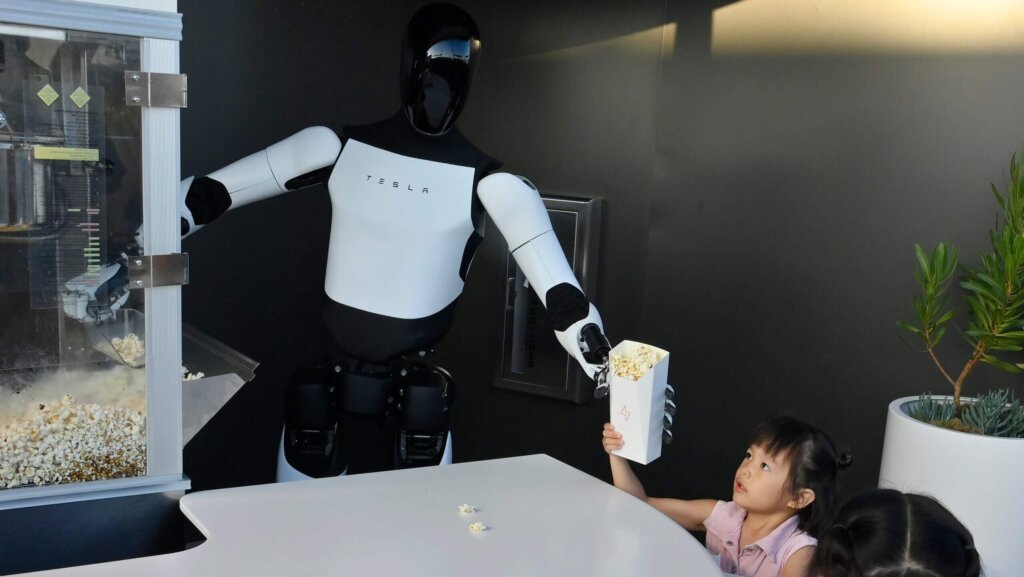
In the heart of Los Angeles, on a stretch of Santa Monica Boulevard once dominated by car lots and billboards, a chrome-plated diner glows like a portal to another time, a retro futuristic timeline. This is Tesla’s new retro-futuristic restaurant: a diner where roller-skating servers glide past humanoid robots, burgers arrive in Cybertruck-shaped boxes, and 45-foot LED movie screens beam cult classics while Teslas charge in the parking lot.
Date night at the @Tesla Diner was such a fun experience!
My first impressions:
– Ordering from the Cybertruck touchscreen was awesome. This is definitely the future of mobile food ordering. FYI, you can avoid waiting in line to get in by ordering this way. They will let you in… pic.twitter.com/lzth7EkDya— Kory Hearn (@koryhearn) July 23, 2025
Opened in July 2025, the Tesla Diner has quickly become a cultural spectacle. Blending 1950s aesthetics with next-gen automation, it’s the first major public manifestation of a growing restaurant trend: AI-powered, nostalgia-driven dining. And it’s not just Tesla. Major chains like McDonald’s and Chipotle are quietly experimenting with cashierless service, robotic fry cooks, and even AI-curated menus. The goal? To streamline operations, combat labor shortages, and capture the attention economy in a TikTok-driven dining landscape.
“This looks like a Pink Floyd video game, but I’m actually hungry,” one diner joked on X (formerly Twitter), sharing footage of Tesla’s humanoid robot, Optimus, serving popcorn with mechanical precision. Another TikTok clip of a roller-skating McDonald’s server has racked up over 3 million views, prompting debates over whether automation is killing jobs or just adding neon flair to an industry in flux.
While restaurant automation isn’t new—Panera, Sweetgreen, and even White Castle have tested various robotics—this particular iteration leans into the retro-future aesthetic to create a multi-sensory experience.
Chef Eric Greenspan, who curated the Tesla Diner’s menu, describes the project as “comfort food for a world that’s changing fast.” Burgers, fries, and shakes are reimagined with a digital-first touch, while the architecture echoes mid-century diners reinterpreted through a sci-fi lens. “It’s Instagram bait, sure,” Greenspan says. “But it’s also genuinely good food served in a way that’s faster, cleaner, and—honestly—fun.”
ADVERTISEMENT
Behind the neon and robots, the back-of-house still makes or breaks the experience. AI-driven ordering is only as fast as the kitchen line, where high-output equipment—think a commercial baking oven with programmable cycles, rapid preheat, and consistent heat distribution—keeps ticket times down and quality up. In concepts like Tesla’s diner, energy-efficient convection and combi units help standardize results across shifts while reducing utility costs, aligning the “faster, cleaner” promise with real-world throughput.
Another newly launched wheeled humanoid robot, XMAN-R1, comes from Shanghai KEENON. It is also used in service scenarios such as hotels, restaurants, and bars. Wheeled mobility efficiently responds to guests’ demands, based on AI drive, autonomous planning and decision-making,… pic.twitter.com/vIxQJqnY9c
— CyberRobo (@CyberRobooo) March 31, 2025
That fusion of utility and spectacle may be the key. The food service industry has struggled with staff retention, rising costs, and shifting consumer habits. With AI in the mix, the industry is struggling to catch up. AI can predict peak hours, manage inventory, and even offer personalized upsells. For diners, it means fewer wait times and more interaction with what feels like a theme park ride.
But this isn’t without pushback. Labor groups warn about job displacement, while critics argue the emphasis on flash could undercut the human element of hospitality. Yet, foot traffic tells another story. According to data from Eater LA and Yelp, the Tesla Diner has been booked out since opening weekend, with average table wait times hitting 45 minutes during peak hours.
Nearly 30% of U.S. workers fear their jobs will be replaced by AI by 2025, with food prep and service workers expressing the most concern. A staggering 80% of restaurant positions could be automated—especially roles like servers (51%) and fast-food counter workers (57%). Despite this, 70% of restaurant operators report difficulties filling open positions, and 45% say they don’t have enough staff to meet demand.
In Q1 2025, the industry saw a net loss of 25,500 jobs, even as it projected adding 200,000 new roles by year’s end. It’s a paradox: automation threatens jobs, yet staffing gaps persist. In that context, AI-powered, retro-futuristic restaurants like Tesla’s are less a novelty and more a symptom—and solution—of a sector in flux.